Understanding Blockchain Transactions
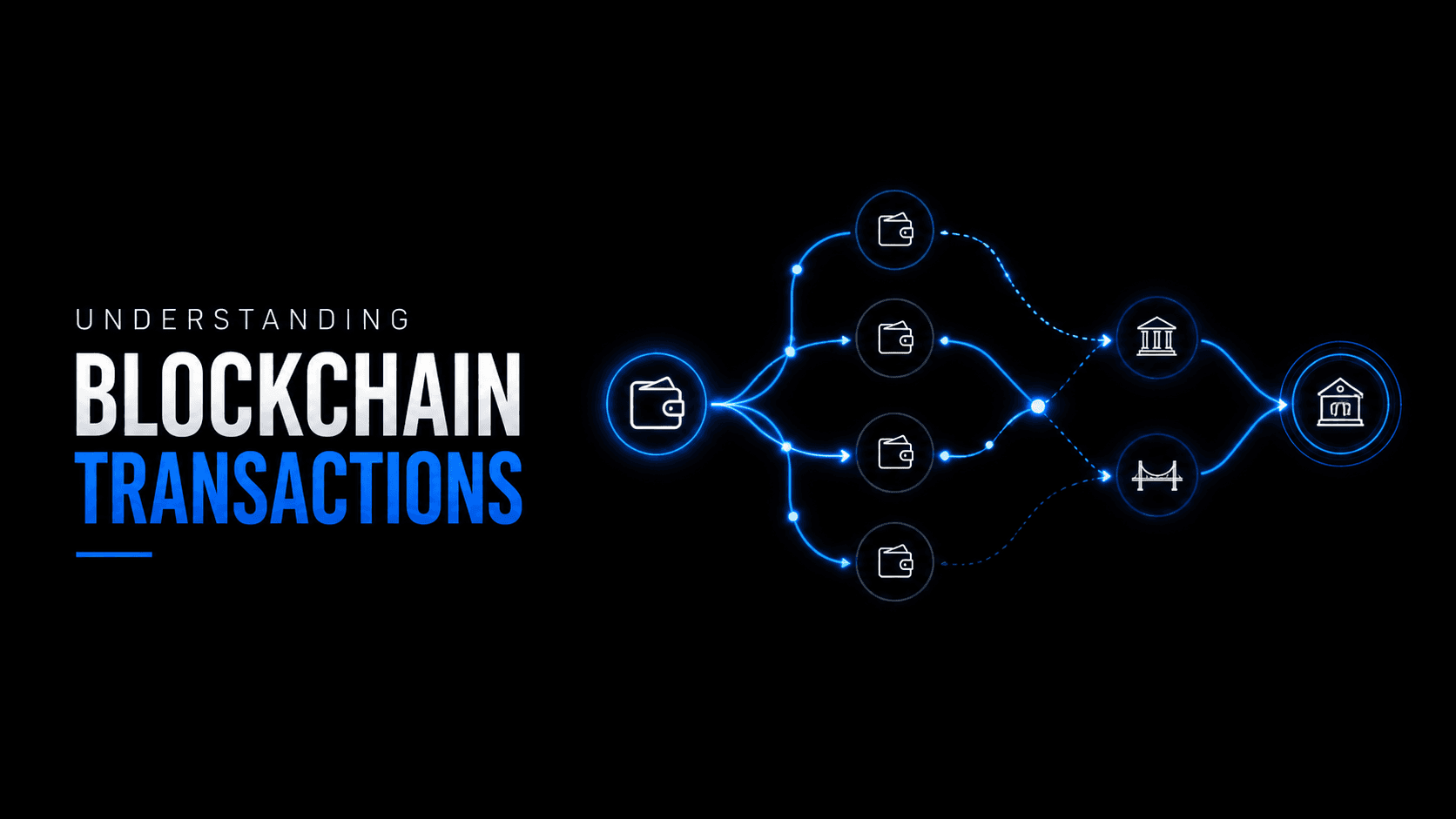
A blockchain transaction is a signed instruction to move value, authorised by whoever controls the funds. It is not a request or a message. Once accepted into a block it becomes a permanent state change on a ledger that every node independently agrees on.
What a transaction contains
The exact fields vary by chain, but every transaction carries:
- Sender — the address authorising the movement
- Recipient — the destination address or contract
- Value — the amount of the native asset being moved
- Fee — what the sender pays for inclusion
- Signature — cryptographic proof the sender authorised it
- Nonce or input reference — which prevents replay and double-spending
Ethereum transactions also carry input data, which can invoke contract logic. A token swap, a transfer and an approval look broadly similar at the top level and differ entirely once that data is decoded.
From signing to broadcast
A wallet assembles the transaction locally and signs it with the private key. The key itself never leaves the device — only the signature is published. The signed transaction is sent to a node, which validates the signature, the available balance and the fee, then relays it to its peers.
At this point the transaction exists but has not happened. It waits in the mempool, pending.
Entering a block
Miners or validators select pending transactions, generally favouring higher fees, and assemble them into a block. When that block is accepted by the network, the transaction has one confirmation and is part of the chain.
Nothing before this is final. A pending transaction can be replaced, evicted, or simply never included at all.
Confirmations and finality
Each subsequent block adds a confirmation, and each one increases the work required to reverse the transaction.
Bitcoin's finality is probabilistic: six confirmations is a widely used convention, not a mathematical guarantee. Ethereum's proof-of-stake finality is explicit — after roughly two epochs a block is finalised, and reversing it would require destroying an enormous amount of staked value.
Bitcoin and Ethereum differ structurally
Bitcoin uses the UTXO model. Addresses hold no balance. A transaction consumes unspent outputs and creates new ones, usually including change that returns to the sender. One transaction may have many inputs and outputs, with no single sender or recipient.
Ethereum uses the account model. Accounts hold balances, and a transfer debits one and credits another. Direction is explicit and there is no change output.
The distinction has direct investigative consequences: reading a Bitcoin change output as a payment to a third party is one of the most common tracing errors, and it inflates apparent flows considerably.
Fees
Fees buy limited block space. They are set by demand for that space rather than by the value being moved, so a large transfer does not inherently cost more than a small one. On Ethereum, fees scale with computational work, which is why a contract interaction costs more than a plain transfer.
What a transaction shows
A confirmed transaction reliably establishes:
- That it occurred, and that it cannot be quietly undone
- The addresses on both sides
- The amount and the asset moved
- Its position in time, through block height and timestamp
- Its place within a wider sequence of movements
These are matters of record, independently verifiable by anyone with access to the chain.
What a transaction cannot prove
On its own, a transaction does not establish:
- Identity — who controls either address
- Intent — why the transfer was made
- Beneficial ownership — who ultimately receives the benefit
- Common control — whether two addresses belong to the same party
- Off-chain context — what agreement or event prompted it
None of this is recorded on-chain, and no amount of analysis extracts it from data that never contained it. Treating an address as a person, or a payment as proof of a relationship, is where readings of transaction data most often go wrong.
Reading a transaction in context
A single transaction is a data point. It tells you precisely what moved and when, and almost nothing about why or by whom.
Intelligence comes from context — the transactions surrounding it, their timing, the counterparties involved and the patterns they form together. Read in isolation, a transaction is a fact. Read in context, it is the starting point of an investigation.